
Every agency wants to deliver a seamless client experience. But for most, the reality is a maze of handoffs, missed details, and last-minute scrambles. If your intake-to-delivery journey is built on a patchwork of tools and ad-hoc processes, you’re leaving money—and client trust—on the table.
With a full-funnel operational blueprint, you can transform intake-to-delivery into a repeatable, scalable machine—one that delights clients, empowers your team, and frees you from chaos. This guide will show you how to map, automate, and optimize every stage of your agency’s journey, from the first client inquiry to the final deliverable.
Table of Contents
- The Real Cost of Siloed Agency Ops
- What Is a Full-Funnel Ops Blueprint?
- Mapping the Intake-to-Delivery Journey
- The 5 Critical Handoffs (and How to Nail Them)
- Automating the Invisible Work
- Metrics That Matter: Tracking Throughput and Quality
- Case Study: From Bottleneck to Breakthrough
- FAQs: Building Your Blueprint
- Next Steps: Start Your Ops Transformation
The Real Cost of Siloed Agency Ops
Most agencies are built on silos. Sales, delivery, creative, and support teams each have their own tools, their own processes, and their own priorities. While specialization can drive excellence, it also creates friction—especially at the handoff points.
- Sales closes a deal, but the delivery team never sees the full scope.
- Onboarding forms are filled out, but key details get lost in email threads.
- Creative teams start work before the client’s goals are fully understood.
- QA is rushed because deadlines are missed upstream.
- Clients get frustrated by repeated questions and inconsistent communication.
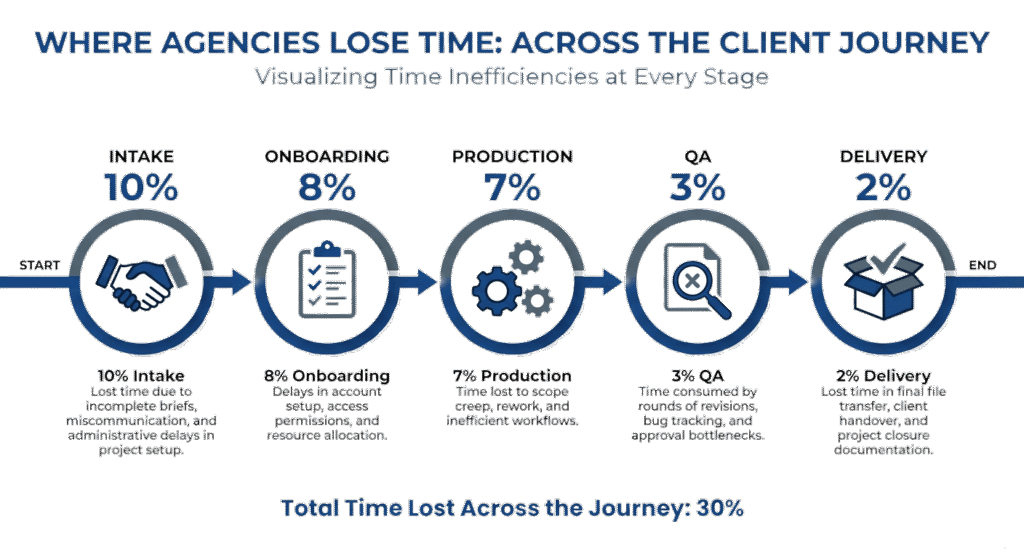
According to BLUECREATIVE’s Efficiency Gap Assessment, agencies lose up to 30% of project time to preventable process gaps. That’s not just a scheduling issue—it’s a profit drain. If your average project is $20,000, you’re losing $6,000 per project to inefficiency. Multiply that by 20 projects a year, and you’re looking at $120,000 in lost value.
What Is a Full-Funnel Ops Blueprint?
A full-funnel ops blueprint is more than a project management template. It’s a documented, step-by-step map of every stage in your client journey—from the first inquiry to the final deliverable and beyond.
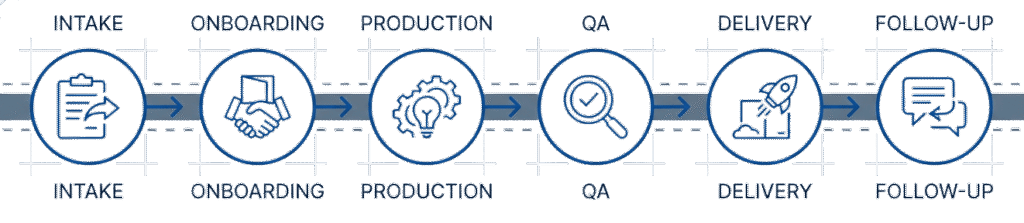
- It covers the entire journey: Sales, onboarding, production, QA, delivery, and follow-up.
- It clarifies roles: Everyone knows who owns each step, what’s expected, and when.
- It automates routine work: No more chasing signatures or manually updating spreadsheets.
- It ensures nothing falls through the cracks: Every handoff is mapped, every checklist is followed, every client touchpoint is intentional.
Clients don’t care about your internal org chart. They care about a smooth, predictable experience. A blueprint aligns your team around that goal, making excellence the default—not the exception.
Mapping the Intake-to-Delivery Journey
Before you can optimize, you have to see the whole picture. Mapping your intake-to-delivery journey means documenting every touchpoint, every handoff, and every potential failure point.
Step 1: List Every Stage
- Intake: How do clients first contact you? What info do you collect?
- Qualification: How do you decide which leads to pursue?
- Proposal: Who creates and sends proposals? How are they tracked?
- Onboarding: What happens after a deal is closed?
- Production: How are tasks assigned and tracked?
- QA: Who reviews work before delivery?
- Delivery: How do you hand off finished work to clients?
- Follow-up: How do you gather feedback and upsell?
Step 2: Identify “Moments of Truth”
- The first kickoff call
- The delivery of the first draft
- The handoff from sales to delivery
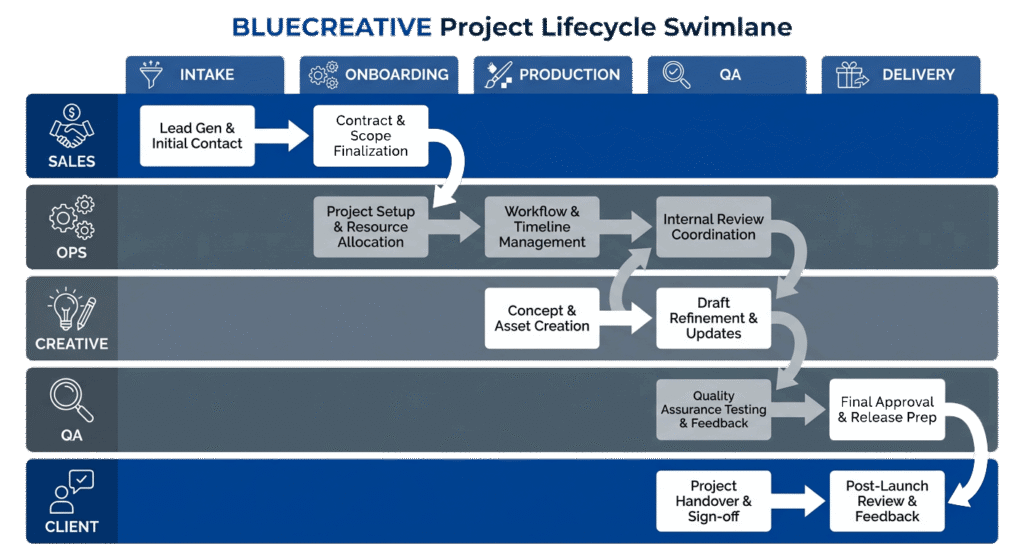
Step 3: Use Swimlane Diagrams
Visualize how work moves between teams. Swimlanes make it clear where handoffs happen and where things get stuck.
The 5 Critical Handoffs (and How to Nail Them)
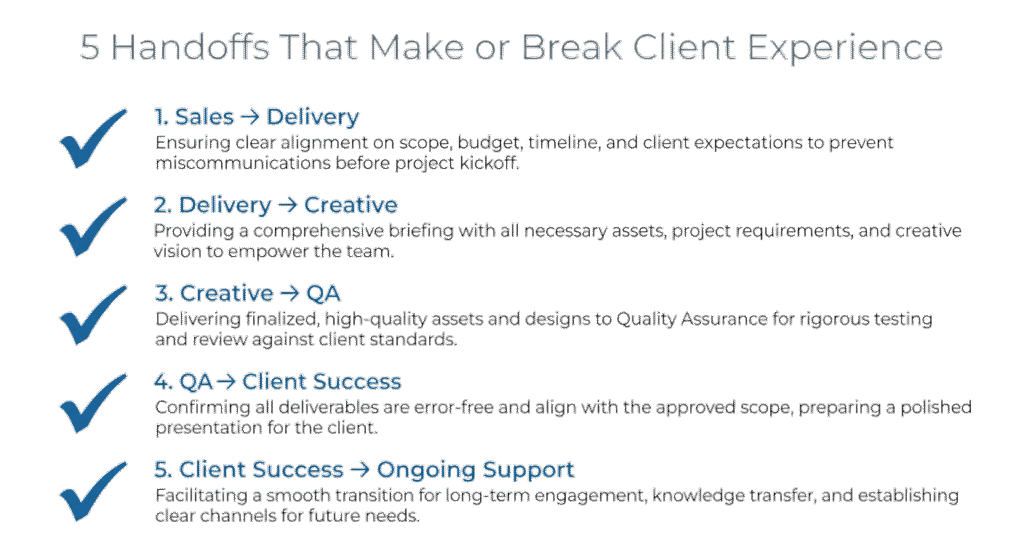
- Sales → Delivery: Use a standardized sales-to-delivery brief. Automate onboarding tasks when a deal is marked “won.” Hold a 15-minute handoff call for every new project.
- Delivery → Creative/Technical: Use detailed briefs with goals, timelines, and client preferences. Attach all relevant files and notes in your project management tool.
- Creative/Technical → QA: Automate task assignments to QA when production is marked complete. Use checklists for every review.
- QA → Client: Use templated review emails and feedback forms. Schedule delivery calls to walk through deliverables.
- Delivery → Support/Account Management: Schedule follow-up and upsell triggers in your CRM. Automate reminders for check-ins and feedback requests.
Automating the Invisible Work
The best agencies don’t just work harder—they work smarter. Automation is the secret weapon that eliminates manual reminders, status updates, and repetitive data entry.
- Auto-create onboarding tasks when a deal closes in your CRM.
- Automate status updates to send clients progress reports at key milestones.
- Trigger QA checklists when production is marked complete.
- Centralize communication by integrating Slack or Teams with your project management tool.
Tool Recommendations:
- Zapier/Make/n8n for cross-tool automation
- ClickUp for workflow triggers, templates, and dashboards
- GHL (GoHighLevel) for CRM and email automation
Metrics That Matter: Tracking Throughput and Quality
You can’t improve what you don’t measure. The right metrics turn your blueprint from theory into a living, breathing system.
- Cycle time: How long does it take to move from intake to delivery?
- Handoff delays: Where do projects get stuck?
- Rework rates: How often do deliverables need to be redone?
- Client satisfaction: Use NPS or CSAT surveys after delivery.
- Capacity: How much work can your team handle at once?
Use dashboards in ClickUp or your PM tool. Visualize bottlenecks with Kanban boards. Set up automated reports to review metrics weekly.
Case Study: From Bottleneck to Breakthrough
Background: A 20-person digital agency was drowning in onboarding delays and missed deadlines. Every new client meant a scramble—sales would close the deal, but delivery never got the full story. Creative teams started work with incomplete briefs, QA was rushed, and clients felt the chaos.
What changed: The agency mapped their full-funnel process, documented every handoff, and automated key steps. They used ClickUp to centralize tasks, Zapier to trigger onboarding workflows, and standardized checklists for QA and delivery.
Results:
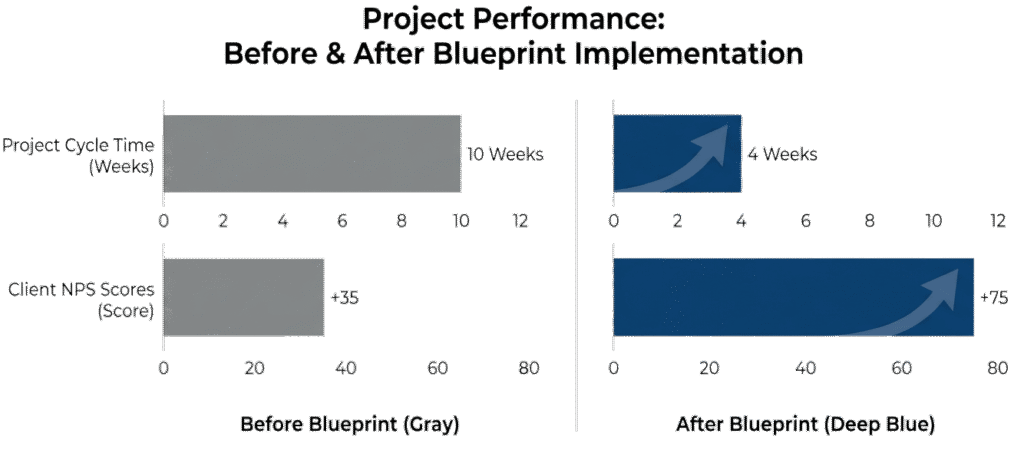
- Project cycle time dropped by 40%.
- Client satisfaction scores rose by 25%.
- The owner reclaimed 10 hours a week and shifted focus to growth.
FAQs: Building Your Blueprint
How long does it take to build a full-funnel ops blueprint?
Most agencies can map and implement the basics in 30–45 days. Start with intake and onboarding, then expand to production and delivery.
Do I need expensive software?
No. Start with what you have—most agencies can automate 80% of their process with ClickUp, Zapier, and a CRM.
What if my team resists change?
Involve them early, show the benefits, and celebrate quick wins. Adoption skyrockets when teams see how much easier their work becomes.
Can this work for small agencies?
Absolutely. The smaller the team, the more impact a clear process has. Even solo agencies benefit from mapping and automating their journey.
How do I keep my blueprint up to date?
Review your process quarterly. Gather feedback from your team and clients, and update your blueprint as your agency grows.
Next Steps: Start Your Ops Transformation
- Siloed processes cost agencies time, money, and client trust.
- A full-funnel blueprint aligns every team and touchpoint.
- Automate handoffs and track metrics to drive continuous improvement.
Ready to build your agency’s full-funnel ops blueprint?
